About the Journal
About the Journal GeoStorage
- Journal History
- Aim and Scope
- Editorial Process
- Open Access Policy
- Author Guidelines
- Publication Ethics
- Plagiarism Policy
- Generative AI Policy
- Copyright & Licences
- R-W-C Policy
- Archiving & Repository Policy
- Journal Busines Model
- Abstract and Indexing
_________________________________________________________________________________
1. Journal History
In June 2025, GeoStorage obtained ISSN numbers (ISSN:3080-8812 (Print); e-ISSN: 3080-8820 (Online)).
GeoStorage launched its inaugural issue on September 25, 2025. It is published quarterly on the 25th of the last month of each quarter, specifically on March 25, June 25, September 25, and December 25.
In June 2026, CODEN assigned to GeoStorage: GEOSFL.
_________________________________________________________________________________
2. Aims and Scope
GeoStorage (Geological Storage) is an international, open-access (OA), and peer-reviewed academic journal. The journal is dedicated to building a high-level, interdisciplinary, cross-regional, and cross-industry academic platform for geological storage engineering involving various types of energy and substances worldwide. It aims to drive innovative development in geological storage science, technology, and engineering, empower the global energy transition, and contribute to the green and sustainable development of human society.
GeoStorage publishes research findings on various geological storage solutions, includes Storage construction, storage site selection, stability and sealing evaluation, injection and mining optimization, safety monitoring, energy efficiency, ground equipment, energy economics. The journal covers a wide range of topics, including:
- Underground storage of oil and gas
- Geological sequestration of carbon dioxide
- Underground storage of hydrogen and helium
- Underground compressed air energy storage
- Underground pumped hydroelectric storage (UPHS)
- Underground thermal energy storage
- Underground grain silos
- Underground reservoir
- Underground geological disposal of nuclear waste
- Underground landfill
_________________________________________________________________________________
3. Editorial Process
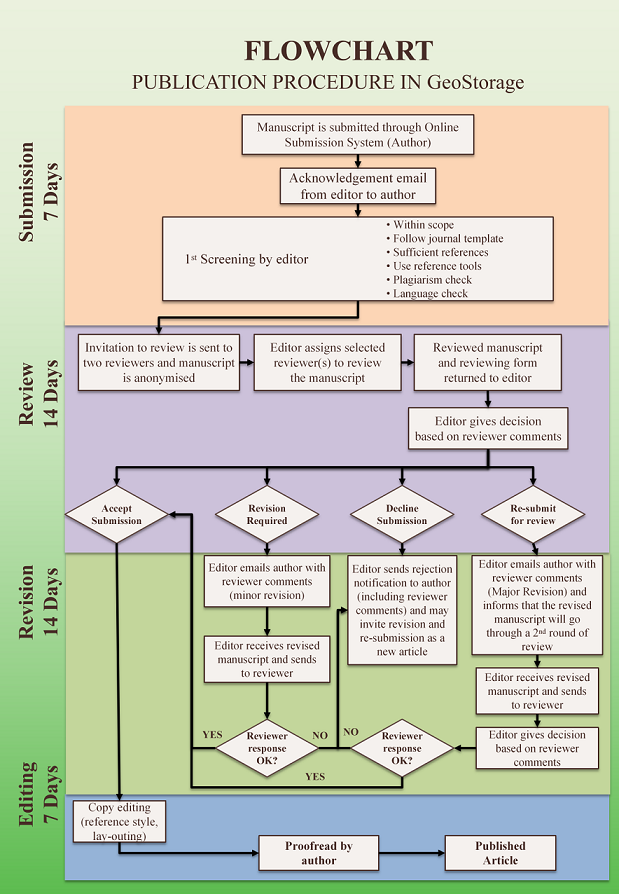
Submitted manuscripts are first reviewed by an editor. The editorial office will evaluate the manuscript to determine whether it aligns with the aims and scope of the journal GeoStorage, whether there are any major methodological flaws, and whether it passes a similarity check. Manuscripts that pass the initial screening will be sent to at least two anonymous reviewers for evaluation (double-blind peer review). Subsequently, the reviewers' comments will be forwarded to the corresponding author for necessary revisions and responses.
The recommended decision will be evaluated at an editorial board meeting. Following this, the editor will send the final decision to the corresponding author. The editor will make the final publication decision based on the feedback from the peer review process. The entire review process typically takes approximately 4 to 6 weeks. The decision categories are as follows:
Reject: Rejected manuscripts will not be published, and the authors will not have the opportunity to resubmit a revised version of the manuscript to GeoStorage.
Resubmit for Review: The submitted manuscript requires reworking and may be accepted after significant changes are made. However, it will be subject to a second round of review.
Accept with Revisions: Manuscripts receiving an "accept-pending-revisions" decision will be published in GeoStorage provided that minor or major modifications are made. The revised manuscript will be reviewed by an editor to ensure that the necessary updates have been completed prior to publication.
Accept: Accepted manuscripts will be published in their current form without requiring any further modifications.
Please refer to the figure below for the manuscript processing flowchart:
_________________________________________________________________________________
4. Open Access Policy
This journal provides immediate open access to its content on the principle that making research freely available to the public supports a greater global exchange of knowledge.
For this open access journal, all published articles are made immediately and permanently free for everyone to read and download under an open access license. Permitted third party (re)use is defined by the following Creative Commons user licenses (CC BY-NC-ND). Under this license, everyone has free and unlimited access to the full-text of the published articles, and is free to re-use the published material under these terms: by giving credit to the author, providing the citation of the original publication, not using for commercial purposes and not distributing the article if you have modified it.
_________________________________________________________________________________
5. Author Guidelines
- Article Types
GeoStorage accepts original research articles, review articles, and case studies.
Original Research Article: An original research article is a manuscript that reports detailed research and is classified as primary literature. Its structure typically includes an introduction, background, hypotheses, methods, results, interpretation of findings, and discussion.
Review Article: A review article provides an up-to-date report on the current state of significant topics in the geological storage sector. It discusses previous developments related to the topic and offers an overview of future directions.
Case Study: A case study is a practical article, often presented by industry practitioners, that details unique instances or challenges encountered in geological storage systems, technologies, or policies. These cases typically provide valuable insights that contribute significantly to the advancement of knowledge in the field.
- General structure of original research paper and case study
Paper Identity: The title should be concise and to the point. Following the manuscript title, list the authors' names and their respective affiliations in order. Finally, provide the complete contact information for the corresponding author, including their email address.
Abstract: The abstract should be written as a single paragraph. The first sentence typically states the purpose of the research, followed by a sentence explaining the methodology. The next sentence provides an overview of the experimental results, and the final sentence outlines the significance of the findings and their broader impact on the field. Additionally, 3 to 6 core keywords should be included.
Introduction: The introduction should briefly review the literature relevant to the research topic. It is generally written in a descriptive manner, starting with a broad theme and gradually narrowing down to the specific research being conducted. The introduction typically consists of multiple paragraphs: the first one or two paragraphs introduce the general background of the research problem to the readers; subsequent paragraphs delve into more specific aspects; and the final paragraph is crucial, as it must clearly state the specific experimental questions the study aims to answer and the approaches that will be used to address them.
Methods: The methods section should provide a direct description of the methodologies employed in the study. This includes a description of the materials used, the main research procedures, data acquisition techniques, and analytical methods. If a specific experimental design is utilized, this section must also detail the design and setup of the research. Similarly, for literature-based research, theoretical or modeling components must be clearly articulated in this section.
Results: The results section should present the research findings objectively and accurately. Representative results are used to highlight the findings and lead into the discussion; this section may include tables, graphs, and diagrams, accompanied by explanations to facilitate readers' understanding. The results should be presented in an order that corresponds to the methods section. The discussion must be separated from the results, and therefore, the discussion should not merely repeat the results.
Discussion: The discussion should interpret the phenomena derived from the research results and relate them to relevant references. The discussion should address the following: What is the significance of the research? Based on the fundamental assumptions, do the results confirm, improve upon, or contradict previous studies? If contradictory findings are observed, the authors must persuade the readers by demonstrating that the findings of this study are superior to existing research.
Conclusion: The conclusion should summarize the research findings, followed by the key takeaways from the discussion. The final, overarching conclusion should end with a statement highlighting the contribution of this research to the field as a whole.
Acknowledgments: This section should declare the funding sources for the research and express gratitude to those who contributed to the research and the preparation of the manuscript.
References: This section must list all references cited in the main text, with accurate citations.
- General structure of review article
Paper Identity: The identity of a review article is the same as that of an original research paper, which includes the title, authors' names, affiliations, and the email address of the corresponding author.
Abstract: Write one or two sentences describing the context and purpose of the review. Next, explain the methodological approach in one or more sentences, including the materials and data used. Then, write a few sentences summarizing the main findings. Finally, conclude with a statement linked to the review's objectives. Additionally, include 3 to 6 strong keywords.
Introduction: The introduction of a review article is generally more concise than that of an original research paper. It typically consists of three main paragraphs covering: (1) Background: Covers general topics, issues, or areas of concern to establish the context; (2) Problem Statement: Highlights trends, new perspectives, research gaps, or conflicts among previous findings; (3) Motivation/Justification: Explains the author's rationale for conducting this literature review.
Materials and Methods: The materials and methods section includes information on data sources, search strategies, article selection criteria, the number of studies included, and the analytical methods or statistical techniques used. The author must ensure that the data sources are clearly identified and valid.
Results and Discussion: The main body of a review article must be organized coherently by topic. The main sections are generally divided into sub-sections based on methodological approaches, models or theories, comparative studies, chronological order, or geographical locations.
Conclusion: The conclusion of a review article differs slightly from that of an original research paper. It generally covers the implications of the findings, the authors' interpretations, and the identification of unresolved research questions.
Acknowledgments: The acknowledgments section in a review article may differ slightly from that of an original research paper. It typically expresses gratitude to individuals or institutions that assisted in searching and providing literature and data, organizing materials, or drafting the manuscript.
References: A review article should generally include no fewer than 20 references, and all of them must be cited in the text.
- Language (usage and editing services)
GeoStorage requires that all submitted manuscripts meet international standards for the English language. To improve the quality of the manuscript, authors may engage a professional language editing service or seek assistance from an English-speaking colleague to polish the language.
- Artworks
Regardless of the application used, when your electronic artwork is finalized, please save it as or convert it to a vector format such as EPS or PDF. Ensure that fonts are embedded or that the text is converted to outlines. Each illustration must have a caption, which should consist of a brief title (not placed on the figure itself) and a concise description. Keep text within the illustrations to a minimum, and explain all symbols and abbreviations used.
- Tables
Tables in GeoStorage typically follow the three-line format. Authors should submit tables in an editable format. Tables may be set in either single-column (full-width) or double-column layout.
- Unit
Use the International Units system.
- Math Formula
Vectors and tensors should be clearly distinguished in the manuscript. Equation numbers should be enclosed in parentheses and numbered consecutively. All equation numbers must appear on the right-hand side of the equation and be referred to within the text. Use the following sequence of brackets: { [ ( ) ] }. Mathematical symbols and formulae should be properly formatted. Particular care should be taken to identify all symbols and avoid ambiguities. A clear distinction must be made between the number one (1) and the lowercase letter "l", as well as between the number zero (0) and the uppercase letter "O". If numerous symbols are used, the author must provide a nomenclature list detailing their meanings and types on a separate page. All parameters must be set in italics, except for descriptive subscripts. British Standards BS 350:1991 and BS 3763, or ISO/R 31, may be referred to for units, abbreviations, and symbols.
- References
GeoStorage references use APA 7th edition. The content of the APA 7th edition can be found on this website: https://apa-citation.com/guides/apa-format/. If you only need a formatted reference, skip ahead and use the APA citation generator — but understanding the rules helps you catch edge cases.
- Conflicts of interest
The corresponding author is responsible for ensuring that all co-authors disclose their interests. Authors must declare any financial or personal relationships with individuals or organizations that could inappropriately influence, or be perceived as biasing, their work. All relevant interests that could be construed as potential conflicts must be disclosed, accompanied by an explanation of why each might represent a conflict. If no such conflicts exist, authors must explicitly state: “The author(s) declare(s) that there is no conflict of interest regarding the publication of this article.” Declared conflicts of interest will be evaluated by editors and reviewers and will be included in the published article.
Authors must disclose any current or recent funding, payments, or services that might influence the submitted work. All funding sources must be detailed in a separate Funding Statement. Additionally, any involvement by non-authors in the conception, planning, design, conduct, analysis, manuscript preparation, editing, or approval for submission must be declared at the time of initial submission.
To ensure impartiality, all submissions involving Editorial Board members undergo a rigorous and independent review process in accordance with the journal’s standard procedures. Board-member authors are strictly excluded from all stages of the review and decision-making process for their own manuscripts, including the selection of potential reviewers. Furthermore, the identities of the reviewers assigned to these manuscripts remain completely confidential from the board-member authors at all times.
_________________________________________________________________________________
- Publication Ethics
- Statement
GeoStorage is committed to upholding the highest standards of publication ethics and takes all possible measures against publication malpractice.
This statement clarifies the ethical behavior of all parties involved in the act of publishing an article in this journal, including the author, the principal editor, associate editors, the editorial board, reviewers, and the publisher. This statement is based on the guidelines of the Committee on Publication Ethics (COPE).
Our responsibility is to publish original work of value to the intellectual community in the best possible form and to the highest possible standards. We expect similar standards from our reviewers and authors. Honesty, originality, and fair dealing on the part of authors, and fairness, objectivity, and confidentiality on the part of editors and reviewers are among the critical core values that enable us to achieve our goal.
GeoStorage is committed to following best practices regarding ethical matters, errors, and retractions, and to providing legal review if necessary.
- Allegation of Research Misconduct
Research misconduct refers to fabrication, falsification, citation manipulation, or plagiarism committed by authors during the conduct, performance, or review of research and in writing articles, or when reporting research results. When an author is found to have engaged in research misconduct, or when other serious irregularities are identified in articles published in scientific journals, editors have a responsibility to ensure the accuracy and integrity of the scientific record.
In cases of suspected misconduct, the editors and the editorial board will follow the best practice guidelines of the Committee on Publication Ethics (COPE) to help resolve complaints and address the misconduct fairly. This includes conducting an investigation into the allegation by the editors. If a submitted manuscript is found to contain such misconduct, it will be rejected. If a published paper is found to contain such misconduct, the journal will issue a retraction notice, which will be linked to the original article.
The first step is to determine the validity of the allegation and to assess whether it meets the definition of research misconduct. This initial step also involves determining whether the individual making the allegation has any relevant conflicts of interest.
If there is a genuine possibility of scientific misconduct or other significant research irregularities, the editors will share the allegation with the corresponding author and request a detailed response on behalf of all co-authors. After the response is received and evaluated, further review and the involvement of experts may be sought. For cases where misconduct is unlikely to have occurred, publishing a letter to the editor for clarification, supplementary analysis, or both—often accompanied by a correction notice and a correction to the published article—will be sufficient.
Relevant institutions are expected to conduct an appropriate and thorough investigation into allegations of scientific misconduct. Ultimately, authors, journals, and institutions share a vital obligation to ensure the accuracy of the scientific record. By responding appropriately to concerns regarding scientific misconduct and taking necessary actions based on the evaluation of these concerns (such as corrections, retractions with replacement, and retractions), GeoStorage will continue to fulfill its responsibility to ensure the validity and integrity of the scientific record, as stipulated in the journal's Plagiarism Policy and R-W-C Policy.
- Complaints and Appeals
GeoStorage will have a clear procedure for handling complaints against the journal, Editorial Staff, Editorial Board, or Publisher. The complaints will be clarified to the respected person with respect to the case of the complaint. The scope of complaints includes anything related to the journal business process, i.e. editorial process, found citation manipulation, unfair editor/reviewer, peer-review manipulation, etc. The complaint cases will be processed according to COPE guidelines.
- Ethical Oversight
If the research involves chemicals, human subjects, animals, procedures, or equipment with inherent unusual hazards, authors must clearly disclose these risks in the manuscript to ensure compliance with ethical standards for animal and human research. Where applicable, authors must provide formal ethical approval from the relevant institutional or regulatory bodies.
Furthermore, if the research involves confidential data or proprietary business/marketing practices, authors must explicitly justify the necessity of such confidentiality and describe the specific measures taken to securely protect or anonymize the information.
- Duties and Responsibilities of Editors
Publication Decisions: The Principal Editor is responsible for determining which submitted manuscripts will be published. This decision is based on the validation of the work, its significance to the field, reviewer comments, and applicable legal requirements concerning libel, copyright infringement, and plagiarism. All submitted manuscripts undergo a rigorous peer-review process by at least two experts in the relevant field. The Principal Editor may consult with other editors or reviewers when making publication decisions.
Fair Play: Editors evaluate manuscripts solely on the basis of academic merit—including importance, originality, validity, and clarity—and their relevance to the journal’s scope. Decisions are made without regard to the authors' race, gender, sexual orientation, ethnic origin, citizenship, religious beliefs, political philosophy, or institutional affiliation. Editorial and publication decisions are independent of any external government policies or agency directives. The Principal Editor holds full authority over the journal’s editorial content and publication schedule.
Confidentiality: Editors and editorial staff must not disclose any information regarding a submitted manuscript to anyone other than the corresponding author, reviewers, potential reviewers, editorial advisers, and the publisher, as appropriate.
Disclosure and Conflicts of Interest: Editors must not use unpublished information or ideas obtained from submitted manuscripts for their own research without the explicit written consent of the authors. Privileged information acquired through handling manuscripts must be kept strictly confidential and never used for personal gain. Editors must recuse themselves from evaluating manuscripts if they have conflicts of interest arising from competitive, collaborative, or other relationships with any of the authors, companies, or institutions associated with the submission. In such cases, another member of the editorial board will be assigned to handle the manuscript.
Management of Unethical Behavior: Editors, in collaboration with the publisher, must take appropriate measures when ethical complaints are raised regarding submitted or published articles. Every reported instance of unethical publishing behavior will be thoroughly investigated, even if discovered years after publication. To support this commitment, GeoStorage has established an Ethics Advisory Board comprising legal experts specializing in intellectual property rights.
- Duties and Responsibilities of Authors
Reporting Standards: Authors of original research must present an accurate account of the work performed and its results, followed by an objective discussion of its significance. Manuscripts should contain sufficient detail and references to permit replication of the work. Review articles must be accurate, objective, and comprehensive, while editorials, opinion pieces, or perspective articles should be clearly identified as such. Fraudulent or knowingly inaccurate statements constitute unethical behavior and are strictly unacceptable.
Data Access and Retention: Authors may be requested to provide the raw data underlying their manuscript for editorial review. They should be prepared to make this data publicly accessible, where practicable, and must retain such data for a reasonable period following publication.
Originality and Plagiarism: Authors must ensure that their work is entirely original. If the work or words of others have been used, they must be appropriately cited or quoted. Plagiarism takes many forms, including passing off another’s paper as one’s own, copying or paraphrasing substantial portions of another’s work without attribution, or claiming the results of research conducted by others. Plagiarism in all its forms constitutes unethical publishing behavior and is unacceptable. To ensure originality, all submitted manuscripts will be screened using plagiarism detection software. Furthermore, each submission must be accompanied by a declaration letter from the authors affirming that the work is free from plagiarism.
Multiple, Redundant, or Concurrent Publications: Manuscripts describing essentially the same research should not be published in more than one journal or primary publication. Authors must not submit a previously published manuscript for consideration. Concurrent submission of the same manuscript to multiple journals constitutes unethical publishing behavior and is strictly prohibited.
Acknowledgment of Sources: Authors must properly acknowledge the work of others and cite publications that have significantly influenced the reported research. Information obtained privately (e.g., through conversations, correspondence, or discussions with third parties) must not be used or reported without the explicit written permission of the source. Similarly, information obtained through confidential services, such as refereeing manuscripts or grant applications, must not be used without the explicit written consent of the relevant authors.
Authorship of the Paper: Authorship should be limited to individuals who have made a significant contribution to the conception, design, execution, or interpretation of the study. All such contributors must be listed as co-authors. Individuals who have participated in substantive aspects of the project but do not meet authorship criteria should be acknowledged or listed as contributors. The corresponding author must ensure that all co-authors have reviewed and approved the final version of the manuscript and have agreed to its submission for publication.
Fundamental Errors in Published Works: If an author discovers a significant error or inaccuracy in their own published work, it is their obligation to promptly notify the journal editor or publisher and cooperate in retracting or correcting the paper. If the editor or publisher learns from a third party that a published work contains a significant error, the author must promptly retract or correct the paper, or provide sufficient evidence to the editor demonstrating the original paper's validity.
Hazards and Human or Animal Subjects: If the research involves chemicals, procedures, or equipment with inherent unusual hazards, authors must clearly identify these in the manuscript. For studies involving human or animal subjects, the manuscript must include a statement confirming that all procedures were performed in compliance with relevant laws and institutional guidelines, and that the appropriate institutional committee(s) approved the study. For human subjects, authors must confirm that informed consent was obtained and that the research adhered to the World Medical Association’s Declaration of Helsinki. The privacy rights of human subjects must always be strictly observed.
Declaration of Competing Interests: All authors must disclose any financial or personal relationships that could be perceived as inappropriately influencing (i.e., biasing) their work. All sources of financial support for the research and/or preparation of the article must be disclosed, along with the role of the sponsor(s), if any, in study design; data collection, analysis, and interpretation; report writing; and the decision to submit the article for publication. If no such involvement existed, this must be explicitly stated. Competing interests must be declared within the manuscript template.
- Duties and Responsibilities of Reviewers
Promptness: Any referee who feels unqualified to review the research reported in a manuscript, or who realizes that a prompt review is impossible, should notify the editor and decline the invitation to review.
Confidentiality: Any manuscripts received for review must be treated as confidential documents. They must not be shown to or discussed with others except as authorized by the editor.
Standards of Objectivity: Reviews should be conducted objectively. Personal criticism of the author is inappropriate. Referees should express their views clearly, supported by reasoned arguments.
Acknowledgment of Sources: Reviewers should identify relevant published work that has not been cited by the authors. Any statement regarding a prior observation, derivation, or argument must be accompanied by the relevant citation. A reviewer should also call to the editor's attention any substantial similarity or overlap between the manuscript under consideration and any other published paper of which they have personal knowledge.
Disclosure and Conflict of Interest: Privileged information or ideas obtained through peer review must be kept confidential and not used for personal advantage. Reviewers should not consider manuscripts in which they have conflicts of interest resulting from competitive, collaborative, or other relationships or connections with any of the authors, companies, or institutions connected to the papers.
_________________________________________________________________________________
- Plagiarism Policy
- Statement and Policy
GeoStorage applies a zero-tolerance policy towards plagiarism. Consequently, we have established the following guidelines detailing specific actions and penalties for any plagiarized content submitted for publication.
Definition: Plagiarism is defined as "the use or close imitation of the language and thoughts of another author and the representation of them as one's own original work."
Policy: All submitted manuscripts must be original, unpublished, and not under consideration for publication elsewhere. Any material reproduced verbatim from another source must be clearly distinguished from the original text through: (1) indentation, (2) quotation marks, and (3) proper source citation.
Any text exceeding fair use standards (defined herein as more than two or three sentences, or the equivalent) or any graphical material reproduced from another source requires explicit permission from the copyright holder and, where feasible, the original author(s). Such material must also be properly cited (e.g., referencing previous publication).
Screening: All submitted papers will be screened for similarity using Crossref Similarity Check.
Enforcement: If plagiarism is detected, the Principal Editor overseeing the manuscript will determine the appropriate measures based on the severity of the offense, in accordance with the following guidelines:
- Similarity Level
GeoStorage maintains a zero-tolerance policy towards plagiarism. We utilize Crossref Similarity Check to evaluate the similarity index, after which the editor determines whether plagiarism has occurred. A similarity report will be provided to the author. The Editorial Board has established the following guidelines:
Similarity Index above 40%: The article will be outright rejected due to poor citation and/or inadequate paraphrasing. No resubmissions will be accepted.
Similarity Index between 10% and 40%: The article will be returned to the author for revision. Authors must provide accurate citations for all similar passages and ensure thorough paraphrasing, even when citations are included.
Similarity Index below 10%: The article may be accepted, subject to citation improvements. Proper citations must be provided for all borrowed text.
For cases in the second and third categories, authors must carefully revise the manuscript, add the required citations, and appropriately paraphrase external material. The revised article must be resubmitted with a new Similarity Check report demonstrating no plagiarism and a similarity index of less than 10%.
- Additional Information
Authors are fully responsible for the content of their submissions. By submitting a manuscript, authors confirm its originality and acknowledge that they have read and understood this plagiarism policy. Should a second instance of severe plagiarism be identified involving the same author(s), the Editorial Board will determine the appropriate disciplinary measures, which may include a permanent ban on submitting future manuscripts to GeoStorage.
This policy also applies to material reproduced from another publication by the same author(s). If an author reuses previously published text or figures, the corresponding sections must be clearly identified and properly cited. It is understood that review articles or tutorial papers may contain substantial previously published material; however, authors must still identify the original sources and obtain permission from both the original author(s) and the copyright holder.
If previously published material is incorporated to clarify new results, it must be explicitly identified, and the distinctions between the prior publication and the current manuscript must be clearly stated. Permission to republish must be obtained from the copyright holder. For manuscripts originally published in conference proceedings and subsequently submitted to GeoStorage (whether identical or expanded), authors must disclose the conference name and publication date, and secure republishing permission from the copyright holder. The Editor reserves the right to reject such submissions. However, authors are permitted to use material from unpublished presentations, including visual displays, in subsequent journal publications. If a manuscript is a translation of a previously published work in another language, authors must disclose the original title, publication date, and journal, and obtain the necessary copyright permissions.
Simultaneous Submission and Overlap: If a manuscript submitted to GeoStorage exhibits significant overlap with a paper simultaneously submitted to another journal, and this is discovered during review or post-publication, the editor of the other journal will be notified, and the case will be treated as severe plagiarism. "Significant overlap" is defined as the use of identical or nearly identical figures, and identical or slightly modified text comprising 50% or more of the paper. Self-plagiarism involving between 10% and 50% of the paper will be classified as intermediate plagiarism. Self-plagiarism confined solely to the Methods section will be considered minor plagiarism.
_________________________________________________________________________________
- Generative AI Policy
- Policy Statement
These policies have been prompted by the rapid rise of generative AI and AI-assisted technologies, which are increasingly being adopted by content creators. Adapted from the COPE AI Policy, these guidelines aim to provide greater transparency and guidance for authors, reviewers, editors, readers, and contributors. MESI will continuously monitor developments in this field and adjust or refine these policies as appropriate.
- For Authors
The Use of Generative AI and AI-Assisted Technologies in Scientific Writing
Please note that this policy applies exclusively to the writing process. It does not cover the use of AI tools for data analysis or generating insights during the research phase.
When generative AI or AI-assisted technologies are used in writing, they should be limited to enhancing the readability and language of the manuscript. Such use must be conducted under strict human oversight. Authors are required to carefully review and edit AI-generated content, as these tools can produce authoritative-sounding output that is inaccurate, incomplete, or biased. Ultimately, authors bear full responsibility and accountability for the content of their work.
Authors must disclose the use of AI and AI-assisted technologies within their manuscript; a corresponding statement will be included in the published work. Declaring the use of these technologies promotes transparency and trust among authors, readers, reviewers, editors, and contributors, while also facilitating compliance with the relevant tool's terms of use.
AI and AI-assisted technologies must not be listed or cited as an author or co-author. Authorship entails responsibilities and tasks that can only be attributed to and performed by humans. Each author is accountable for ensuring that any questions regarding the accuracy or integrity of the work are appropriately investigated and resolved. Furthermore, authorship requires the ability to approve the final version of the manuscript and agree to its submission. Authors are also responsible for ensuring the work is original, that all listed authors meet authorship criteria, and that the work does not infringe upon third-party rights. We strongly encourage authors to familiarize themselves with our Ethics in Publishing policy prior to submission.
The Use of Generative AI and AI-Assisted Tools in Figures, Images, and Artwork
The use of generative AI or AI-assisted tools to create or alter images in submitted manuscripts is strictly prohibited. This prohibition includes enhancing, obscuring, moving, removing, or introducing specific features within an image or figure. Adjustments to brightness, contrast, or color balance are acceptable, provided they do not obscure or eliminate any information present in the original image. Please be advised that image forensics tools or specialized software may be applied to submitted manuscripts to identify suspected image irregularities.
The sole exception to this policy is when the use of AI or AI-assisted tools is an integral part of the research design or methodology (e.g., AI-assisted imaging approaches used to generate or interpret underlying research data, such as in biomedical imaging). In such cases, the use of AI must be described in a reproducible manner within the Methods section. This description should detail how the AI or AI-assisted tools were used in the image creation or alteration process, and must include the name of the model or tool, its version and extension numbers, and the manufacturer. Authors are required to adhere to the specific usage policies of the AI software and ensure proper content attribution. Where applicable, authors may be asked to provide pre-AI-adjusted versions of the images and/or the composite raw images used to create the final submitted versions for editorial assessment.
Furthermore, the use of generative AI or AI-assisted tools to produce artwork, such as graphical abstracts, is not permitted. However, the use of generative AI for cover art may be allowed on a case-by-case basis. To qualify for this exception, authors must obtain prior written permission from the journal editor and publisher, demonstrate that all necessary rights have been cleared for the relevant material, and ensure proper content attribution.
- For Reviewers
The Use of Generative AI and AI-Assisted Technologies in the Journal Peer Review Process
When a researcher is invited to review a manuscript, that document must be treated as strictly confidential. Reviewers must not upload a submitted manuscript, or any portion thereof, into a generative AI tool. Doing so may violate the authors’ confidentiality and proprietary rights, and if the manuscript contains personally identifiable information, it may also constitute a breach of data privacy regulations.
This confidentiality requirement extends to the peer review report itself, as it may contain sensitive information regarding the manuscript and/or the authors. Therefore, reviewers must not upload their review reports into AI tools, even for the sole purpose of improving language or readability.
Peer review is the cornerstone of the scientific ecosystem, and AE upholds the highest standards of integrity throughout this process. Evaluating a scientific manuscript entails responsibilities that can only be attributed to humans. Generative AI or AI-assisted technologies must not be used to assist in the scientific review of a paper. The critical thinking and original assessment required for peer review fall outside the scope of these technologies, which carry the risk of generating incorrect, incomplete, or biased conclusions. Ultimately, the reviewer remains fully responsible and accountable for the content of the review report.
Please note that AE’s policy permits authors to use generative AI and AI-assisted technologies during the writing process prior to submission, strictly to enhance the language and readability of their manuscript, and only with appropriate disclosure as outlined in the AE Guide for Authors. Reviewers can locate this disclosure statement at the end of the manuscript, in a dedicated section preceding the reference list.
- For Editor
The Use of Generative AI and AI-Assisted Technologies in the Journal Editorial Process
A submitted manuscript must be treated as strictly confidential. Editors must not upload a submitted manuscript, or any portion thereof, into a generative AI tool. Doing so may violate the authors’ confidentiality and proprietary rights, and if the manuscript contains personally identifiable information, it may also constitute a breach of data privacy regulations.
This confidentiality requirement extends to all communications regarding the manuscript, including notification and decision letters, as they may contain sensitive information about the manuscript and/or the authors. Therefore, editors must not upload their correspondence into AI tools, even for the sole purpose of improving language or readability.
Peer review is the cornerstone of the scientific ecosystem, and AE upholds the highest standards of integrity throughout this process. Managing the editorial evaluation of a scientific manuscript entails responsibilities that can only be attributed to humans. Generative AI or AI-assisted technologies must not be used by editors to assist in the evaluation or decision-making process. The critical thinking and original assessment required for this work fall outside the scope of these technologies, which carry the risk of generating incorrect, incomplete, or biased conclusions. Ultimately, the editor remains fully responsible and accountable for the editorial process, the final decision, and the communication thereof to the authors.
Please note that AE’s policy permits authors to use generative AI and AI-assisted technologies during the writing process prior to submission, strictly to enhance the language and readability of their manuscript, and only with appropriate disclosure as outlined in the AE Guide for Authors. Editors can locate this disclosure statement at the end of the manuscript, in a dedicated section preceding the reference list. Should an editor suspect that an author or reviewer has violated our AI policies, they must promptly report the matter to the publisher.
_________________________________________________________________________________
- Copyright & License
Copyright transfer ensures maximum international protection and facilitates the efficient processing of reprint requests. It encompasses inclusion in document delivery services, electronic journal databases, and online journal versions.
A Creative Commons Attribution-NonCommercial-NoDerivatives 4.0 International (CC BY-NC-ND 4.0) license is granted. This permits readers to share (copy and redistribute) the material in any medium or format, subject to the following terms:
Attribution: Users must give appropriate credit, provide a link to the license, and indicate if changes were made. This may be done in any reasonable manner, but not in a way that suggests the licensor endorses the user or their use.
NonCommercial: The material may not be used for commercial purposes.
NoDerivatives: If the material is remixed, transformed, or built upon, the modified material may not be distributed.
Author Rights: Each author retains moral rights to their article(s), including the right to be identified as the author(s) whenever and wherever the article is cited or published. Assigning copyright does not forfeit the authors’ rights to reprint their article(s) or publish them elsewhere. Authors may do so after obtaining written permission from the editors, or without such permission provided the terms of the CC BY-NC-ND 4.0 license are met and GeoStorage is acknowledged as the original source.
Employer Copyright: In cases where a contributor’s employer (e.g., a government agency) holds the copyright to an article, the authors must provide the editors with written non-exclusive permission to handle reprint requests from third parties.
Author Certifications: By signing the copyright form, authors certify that: The submitted article is their original work, has not been previously published, and is not under consideration for publication elsewhere. They have obtained permission for, and properly acknowledged the source(s) of, any quoted excerpts or paraphrased references used in the text, tables, figures, and algorithms.
To the best of their knowledge, the article is free of libelous, unlawful, or otherwise actionable content.
_________________________________________________________________________________
- Retraction, Withdrawal, & Correction (R-W-C) Policy
- Policy Statement
We recognize that authors exercise great care in preparing their manuscripts, and we conduct rigorous peer-review processes. Nevertheless, under exceptional circumstances, published articles may occasionally require withdrawal or removal for scientific reasons. Such actions are never taken lightly. Therefore, corrections, clarifications, retractions, and apologies will be implemented in strict accordance with established standards to preserve confidence in the integrity of our electronic archives. It is our firm commitment and policy to maintain the completeness and reliability of the scientific record for researchers and librarians.
- Content Integrity and Maintenance
Applying the CrossMark icon is a commitment by GeoStorage to maintain the content published and alert readers to changes if and when they occur. CrossMark, a multi-publisher initiative from CrossRef, provides a standard way for readers to locate the authoritative version of a document. GeoStorage recognizes the importance of the integrity and completeness of the scholarly record to researchers and librarians and attaches the highest importance to maintaining trust in the authority of its electronic archive. Clicking on the CrossMark icon will inform the reader of the current status of a document and may also provide additional publication record information about the document.
- Article Retraction
GeoStorage is committed to maintaining the integrity of the scholarly record; therefore, on occasion, it is necessary to retract articles. Articles may be retracted under the following circumstances:
Major Scientific Errors: There is a major scientific error that invalidates the article's conclusions. This includes clear evidence of unreliable findings resulting from either misconduct (e.g., data fabrication) or honest error (e.g., miscalculation or experimental error).
Redundant Publication: The findings have been previously published elsewhere without proper cross-referencing, permission, or justification.
Ethical Violations: There are ethical issues, such as plagiarism (appropriating another person's ideas, processes, results, or words without appropriate credit, including material obtained through confidential peer review) or inappropriate authorship.
To ensure that retractions are handled in accordance with publication best practices and the COPE Retraction Guidelines, GeoStorage adheres to the following process:
Identification: Any article potentially requiring retraction is brought to the attention of the journal editor.
Investigation: The editor follows the step-by-step COPE flowcharts, which includes evaluating any response provided by the author(s) in question.
Ethics Review: Before any action is taken, the editor's findings are submitted to the Ethics Advisory Board to ensure a consistent approach aligned with industry best practices.
Decision and Notification: The final retraction decision is communicated to the author(s) and, when necessary, to other relevant bodies, such as the author's institution.
Publication: A formal retraction statement is posted online and published in the next available issue of the journal (see below for further details).
Please note that an author's retention of copyright does not automatically grant them the right to retract an article post-publication. The integrity of the published scientific record is of paramount importance, and COPE’s Retraction Guidelines apply strictly in all such cases.
- Article Withdrawal
The author is not allowed to withdraw submitted manuscripts, because the withdrawal is a waste of valuable resources that editors and referees spent a great deal of time processing submitted manuscript, and works invested by the publisher. For attention, before the author submits the manuscript through our OJS, the author is obliged to approve the checklist that we provide.
- Article Correction
GeoStorage may issue corrections for reliable publications containing flawed data, misleading information due to honest error, or incorrect authorship lists. These corrections fall into three categories: errata for publisher-introduced errors, corrigenda for author-introduced errors, and addenda for supplementary explanations or updates. While Handling Editors may consult reviewers or the Editorial Board and request clarification from authors, the final decision regarding the necessity and type of correction rests solely with the Editor(s).
- Article Removal
In an extremely limited number of cases, it may be necessary to remove a published article from our online platform. This will only happen if an article is clearly defamatory, or infringes others’ legal rights, or where the article is, or we have good reason to expect that it will be, the subject of a court order, or where the article, if acted upon, may pose a serious health risk. In such circumstances, while the metadata (i.e. title and author information) of the article will be retained, the text will be replaced with a screen indicating that the article has been removed for legal reasons.
- Article Replacement
In cases where an article, if acted upon, may pose a serious health risk, the Authors of the original paper may wish to retract the flawed original and replace it with a corrected version. Under such circumstances, the above procedures for retraction will be followed with the difference that the article retraction notice will contain a link to the corrected re-published article together with a history of the document.
_________________________________________________________________________________
- Archiving& Repository Policy
GeoStorage utilizes the LOCKSS system to establish a distributed archiving network among participating libraries, enabling them to create permanent, authoritative archives of the journal for long-term preservation and restoration.
GeoStorage recognizes the importance of maximizing the visibility and accessibility of scholarly research by supporting self-archiving. GeoStorage’s repository policy is designed to facilitate the broad dissemination of research while respecting the rights of authors and the interests of the journal. By permitting the archiving of various versions of scholarly articles, GeoStorage ensures that research is accessible to a wider audience, thereby increasing its citation rate and overall impact.
To further enhance the dissemination and impact of published research, GeoStorage allows authors to archive specific versions of their work in institutional or subject-specific repositories (e.g., PubMed Central, arXiv, SSRN) relevant to their field. Additionally, GS encourages transparency by directing authors to international policy tracking databases, such as Sherpa/Romeo, Diadorim, Dulcinea, and Mir@bel, ensuring easy access to clear and up-to-date open access policies worldwide.
_________________________________________________________________________________
- Journal Business Model
All readers and authors of GeoStorage can enjoy the benefits of free open access. We believe that free open access promotes accessibility and use throughout the world, serving the professional and scientific community, as well as the wider community. GeoStorage does not charge a fee for its publications.
All accepted articles will be provided with free access to readers, covering the costs of peer review management, journal production, online hosting, and long-term archiving. There will be no Article Processing Charges (APC) imposed on the authors or any related parties. Articles accepted, will still be provided with open access without any APC fees.
We kindly request that authors ensure this free access is available before submission, and we guarantee that the peer review process will not be affected by any charges.
Additional information: The operational funding for the GeoStorage journal is provided by its journal council. The council organizes annual expert evaluations of journal quality and holds regular meetings to discuss key issues regarding the journal's development.
_________________________________________________________________________________
- Abstract and Indexing

